
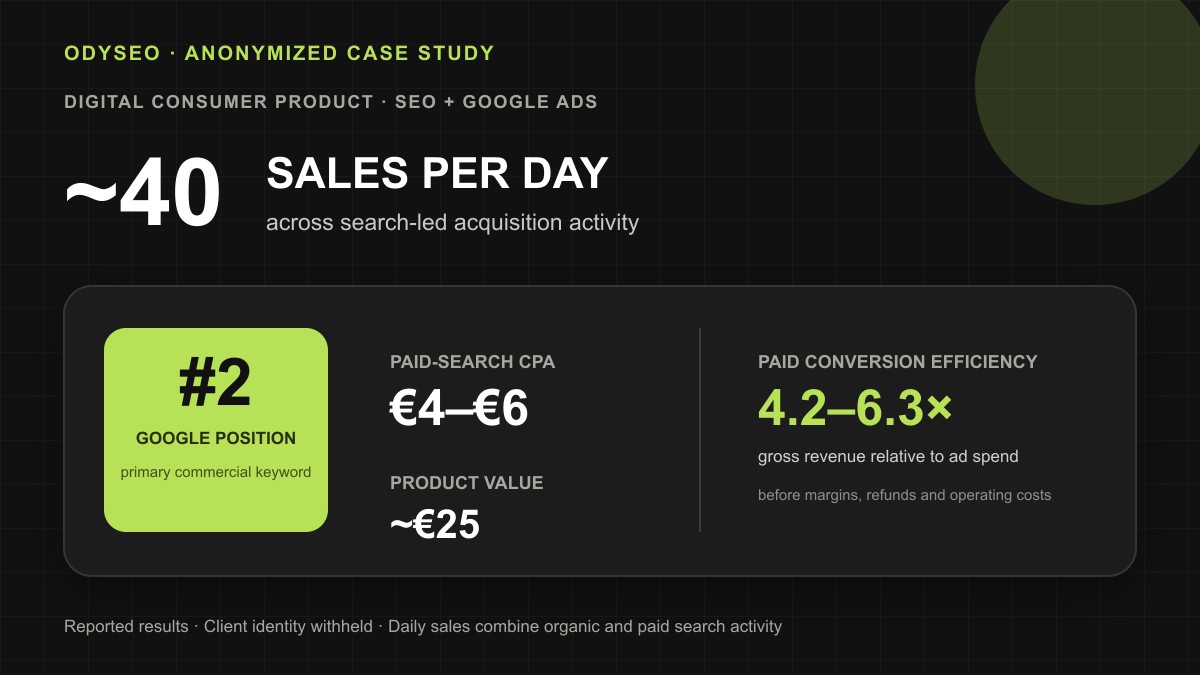
~40
Sales per day
#2
Primary commercial keyword
€4–€6
Paid-search CPA
~€25
Product value
From a #2 Google ranking to approximately 40 sales per day.
A digital consumer-product company operated in a market where customers frequently searched for the product category before purchasing.
Demand already existed. The opportunity was to capture more of it by coordinating organic visibility and paid acquisition around the searches closest to a sale.
The challenge
The business needed more than additional website traffic.
It needed to rank for its most commercially important search terms, strengthen its primary landing pages and capture additional demand through paid search without allowing acquisition costs to undermine the economics of a €25 product.
What we changed
We built one coordinated search strategy rather than treating SEO and Google Ads as separate channels.
The work included:
- Prioritising purchase-intent commercial keywords
- Optimising the primary product and landing pages
- Building supporting content around the main commercial category
- Strengthening internal links toward high-value pages
- Running Google Ads for proven purchase-intent searches
- Continuously optimising bids, CPC and paid conversion costs
SEO established long-term visibility, while Google Ads captured additional demand around the same commercial intent.
The results
During the measured period, the business achieved:
- Approximately 40 sales per day across its search-led acquisition activity
- A #2 Google position for its primary commercial keyword
- A €4–€6 paid-search cost per acquisition
- An approximately €25 product value
On tracked paid conversions, a €4–€6 CPA against a €25 purchase value represents approximately 4.2–6.3 times gross revenue relative to advertising spend, before margins, refunds or other operating costs.
Organic search contributed additional sales without an incremental media cost.
Why it worked
SEO and paid search reinforced one another.
Organic visibility established authority and captured persistent demand. Paid search expanded coverage and provided faster performance data around the queries most likely to convert.
The result was a search presence built around sales—not traffic for its own sake.